
Interviewing Avatars: The Future of Hiring
Meeting the future: Can AI assistants replace the irreplaceable human touch?

It's 2027, and the office needs an assistant to organize meetings. Not just any assistant, though. This time, the job posting has drawn a unique mix of candidates: 20 humans with varied experiences and 35 AI personas, each designed for specific skills, from efficiency-driven precision to warm interpersonal engagement. The selection process will be unlike any other, with both human and AI contenders meeting an AI recruiter for interviews. The criteria? Speed of answers, adaptability, personality, and even visual appearance—all matter. After all, everyone has an avatar, both humans and bots.
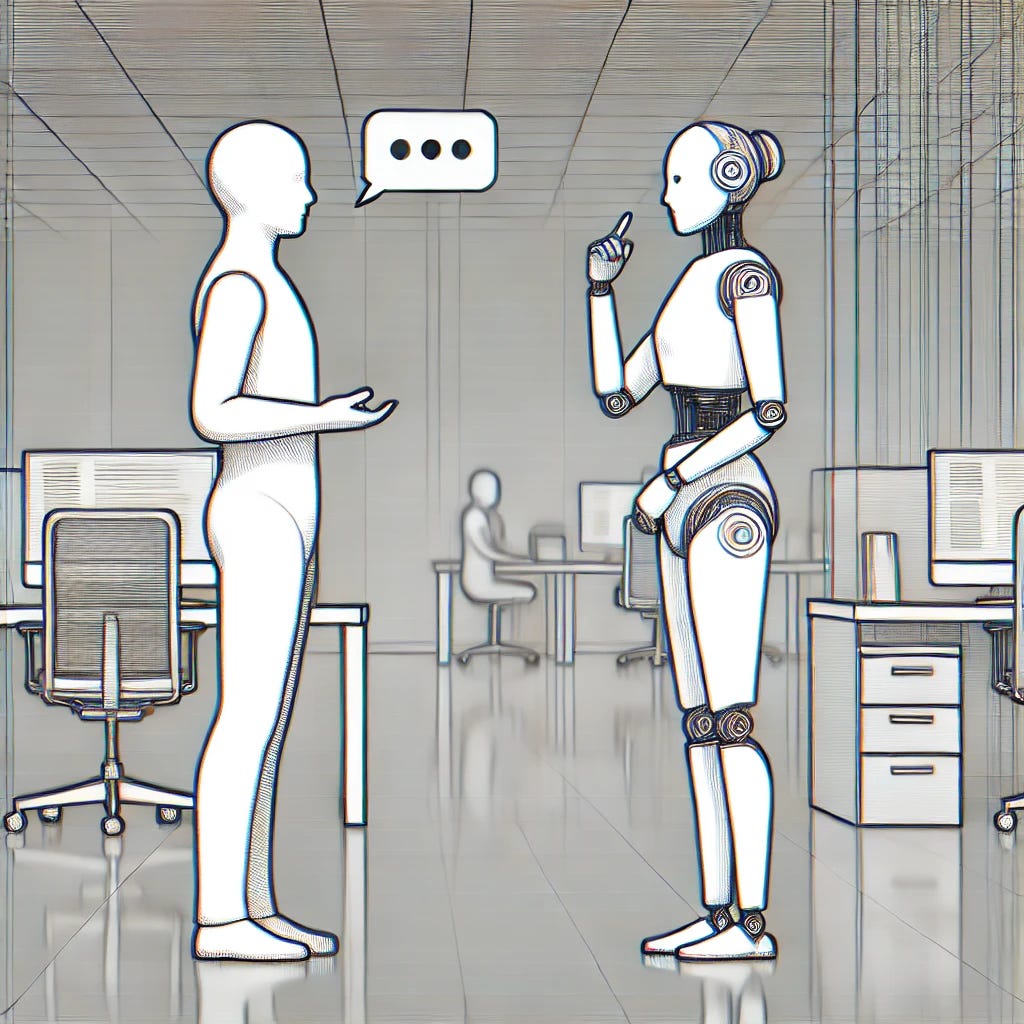
The AI recruiter, known as "Orion," is a sophisticated system created specifically to evaluate both human and artificial talents without bias. Orion's digital face appears as a serene, almost meditative visage projected onto a screen in the office's interview room. For each interview, Orion can adapt its questioning style and language to suit the interviewee, drawing on an extensive dataset to tailor inquiries to elicit meaningful responses from humans and AIs alike.
The interview process begins with alternating candidates—a human, then an AI, then back to a human. Orion's first task: understanding not just the technical qualifications of each candidate but also their nuances, their strengths, their unique capabilities. For the human candidates, Orion asks questions that reveal their emotional intelligence: "How would you handle a scenario where two executives demand the same meeting slot?" or "Tell me about a time when your organizational skills helped resolve a crisis." The human responses vary, ranging from recounting real-life stories of conflicts at work to creative, empathetic solutions that showcase the value of a lived experience.
Next, Orion turns to an AI candidate—a scheduling system called "Athena." Athena is asked similar questions, but with a twist: "How would you resolve a scheduling conflict if one participant is noted for their lack of punctuality?" Athena responds almost instantly, noting it would prioritize reminders and send strategic nudges to ensure compliance. Orion nods—metaphorically speaking—marking Athena's speed, yet also considering whether its solution could address the human complexity of someone simply not feeling motivated to attend.
Another human candidate steps in, a project coordinator named Julia. She explains how she once managed to secure a crucial meeting by appealing to a colleague's sense of urgency in a personal, direct conversation—something an AI, she argues, couldn't replicate with the same depth. Orion takes note, impressed by the adaptability Julia demonstrates, understanding the subtleties of human behavior and motivation.
The next AI in line is "MeetMate," designed with a personality module that simulates a friendly, casual conversational tone. When Orion asks MeetMate how it would handle rescheduling a last-minute meeting cancellation, MeetMate responds with charm: "I'd inform the participants in a way that minimizes frustration—something like 'Hey there! Things change, and so do meetings. Here are some alternative slots that work just as well!'” MeetMate’s response aims to bring a touch of warmth and ease, something that might resonate well in a modern, informal office culture.
As the interviews progress, a pattern emerges. Human candidates shine in areas like conflict resolution, empathy, and understanding unspoken social dynamics—qualities that no AI, regardless of how advanced, can truly replicate. On the other hand, AI candidates excel in efficiency, multitasking, and the sheer speed at which they can analyze and coordinate schedules, often predicting potential conflicts before they even arise. Orion must weigh these differing strengths carefully.
The final phase of the interview process involves simulated scenarios. Each candidate—human and AI—is put through a live exercise. They must coordinate an intricate meeting involving eight busy executives across three time zones, some with a history of being late or difficult to reach. The human candidates make phone calls, send personalized emails, and even leverage social cues they’ve gathered over time. The AI candidates, by contrast, crunch data, assess availability at lightning speed, and adjust settings automatically, considering all potential variables in seconds.
Orion’s challenge is to decide: what matters most in this modern office? The empathetic touch of a human who understands the subtleties of people’s moods and motivations? Or the precision and unwavering consistency of an AI that never tires, never overlooks a detail, and never grows frustrated? Perhaps, the answer lies not in choosing one over the other but in finding a way for them to collaborate—an efficient AI mind with a human heart to guide it.
The interview process ends, but the decision remains. To finalize the evaluation, a table with all the KPIs is generated. Each candidate—human and AI—is scored on metrics like speed of response, adaptability, efficiency, and, crucially, empathy. For compliance reasons, a human will ultimately need to make the final decision, ensuring that the intangible aspects like empathy are given their due weight. The decision will also depend on who the stakeholders are: luxury-oriented stakeholders are likely to prefer a human assistant, expecting a more personal touch, while others may have no choice but to accept an AI. The office might just need a combination—one human, one AI, working side by side, covering for each other's weaknesses, amplifying each other's strengths. The office might just need a combination—one human, one AI, working side by side, covering for each other's weaknesses, amplifying each other's strengths. After all, in 2027, the future of work might not be as idealistic as partnership alone. It’s about survival, adaptation, and the harsh realities of efficiency versus empathy. The narrative of partnership is appealing, but the truth is that many stakeholders will prioritize output and cost savings over human connection.